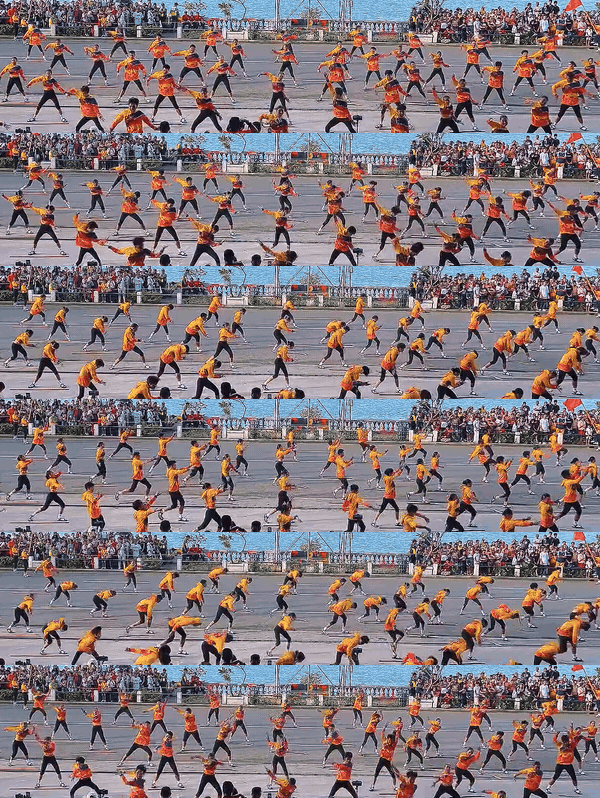
Grip or Slip: Friction and Performer Footwear in the Cry of Jelicuon
What you’ll learn
By the end of this lesson, you will be able to:
- 1Differentiate static friction from kinetic friction.
- 2Identify two factors that affect friction: the surfaces in contact and how hard they press together.
The player pauses at checkpoints to test your understanding. Too fast? Tap the speed button to slow the narration, use 10s to hear a part again, and keep subtitles on to read along.
Subtitles appear here while the video plays.
Read the full transcript
[Theme Music]
You’re moving into a new house, and you ask a friend to come help out, which he does, because he’s just nice like that.
And you really do need his help, because you’ll have to move giant bookcases and a desk,
and you can’t do all of that on your own.
And about halfway through the move-in, you’re rearranging the furniture in your new bedroom
when you run into a problem:
You’re pushing and pushing on your bookcase, but it just not sliding across the floor.
So you call your friend over from the other room, and with both of you pushing, the bookcase finally starts to slide.
But it was really hard to get it moving -- and stay moving -- because there’s a force working
against you - stopping the bookcase from sliding: friction.
And there are actually two kinds of friction.
First, there’s KINETIC friction -- that’s the force that slows the bookcase down as it slides.
And there’s also STATIC friction — the force you had to overcome to get it moving in the first place.
So let’s talk about kinetic friction first.
It’s a resistive force, which just means that no matter what, it’ll act to resist you.
In other words, if you push the bookcase so it slides to the left, then the force of kinetic
friction is acting to the right.
But if you move the bookcase to the right, then the friction will resist to the left.
Kinetic friction will also often generate heat or sound or both.
So, what causes it?
The bookcase and the wood floor might LOOK smooth, but if you looked at their surfaces
under a microscope, you’d see that they’re covered in tiny bumps and grooves.
As the bookcase slides across the floor, the surfaces catch on each other,
and might even start to form weak intermolecular bonds. That pulls on the bookcase, slowing it down.
But as the bookcase continues to slide, it breaks those bonds and moves past whatever bumps it was stuck on.
The newly-freed molecules start to spring back, and the movement produces heat and sound.
Then the cycle continues with the next patch of floor.
You end up with a force that resists any kind of sliding movement, and its strength depends
partly on what materials are sliding against each other.
Rougher materials have more surfaces to catch on each other, which is why the bookcase will
be easier to slide on the wood floor than if you’d tried it on carpet.
And the way in which this roughness affects kinetic friction is called the coefficient of kinetic friction,
and it’s different for pretty much every combination of materials.
But there’s another factor at work in friction:
How hard the materials are pressed together puts more of their surfaces in contact with each other.
And that’s where the normal force, or F_N, comes in.
Quiz Checkpoints
The video describes *static friction*. Before a heavy prop chest starts to slide across the stage, the crew has to push hard. What is static friction doing?
The video says friction depends on what materials are sliding against each other. A performer's shoes grip the gym floor well but slip on a freshly polished stage. What changed?
The video says friction also depends on how hard the surfaces are pressed together. A heavier performer and a lighter performer wear the same shoes on the same floor. Who gets more friction?
See It in the Festival
The same physics, in the Cry of Jelicuon.