Equilibrium: Forces in a Balanced State
What you’ll learn
By the end of this lesson, you will be able to:
- 1Describe equilibrium as a state in which the forces on an object are balanced.
- 2Identify the balanced forces acting on an object at rest.
The player pauses at checkpoints to test your understanding. Too fast? Tap the speed button to slow the narration, use 10s to hear a part again, and keep subtitles on to read along.
Subtitles appear here while the video plays.
Read the full transcript
What if this time you really feel a high level of confidence like never before,
like it's definitely your time to win something from the claw machine,
maybe a genius newton plushie,
but when the claw actually does picks up the box,
the machine suddenly stops working on its way to the hole
and your prize is just dangling there, silent.
That would be sad, yes, and you’re going to be angry,
but that situation is also a good example of equilibrium!
As you know in Newton’s first law,
a body remains at its initial state unless there is force acting on it.
So if a body is at rest,
it will keep its current state as long as there is no net force
(a force that represents the sum of all forces)
or it’s equal to zero.
This also happens when the object is in motion at uniform velocity,
it will keep moving.
This condition of the absence of net force or resultant force is called equilibrium.
Here the weight of the box of a souvenir (w),
is balanced by the force of the claw (F) pulling it upward
so it stays still.
But is it enough to achieve equilibrium?
Quiz Checkpoints
The video says an object at rest stays at rest when the net force on it is zero. A loaded prop riser stands still in the plaza. What is the net force on it?
Like the prize box held by the claw, a performer holds a festival banner pole perfectly still. Which statement is true?
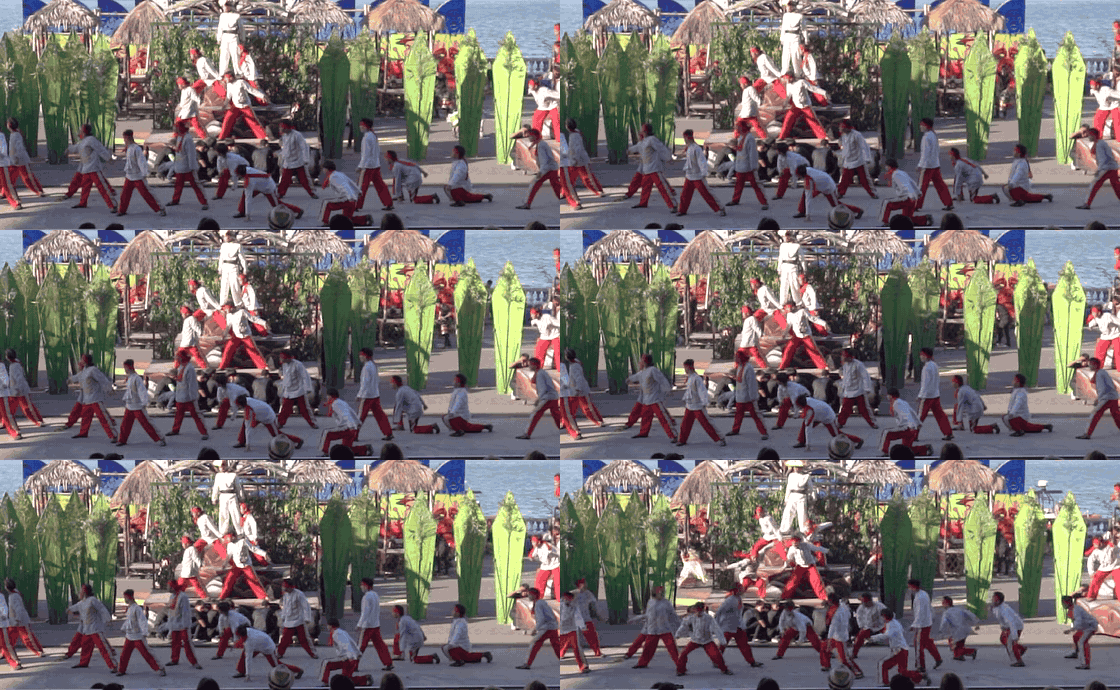
See It in the Festival
The same physics, in the Cry of Jelicuon.