


_Municipal_Seal.png&w=64&q=75 "Municipality of New Lucena, Iloilo")
Newton's First Law — The Inertia of the Riser
Every Cry of Jelicuon performance ends with a race against time: heavy bamboo risers must be cleared from the stage before the next school performs. Teachers push with all their strength — but the riser barely budges at first. This is Newton's First Law in action: an object at rest stays at rest unless acted upon by a net external force. The greater the mass of the riser, the greater its inertia — its resistance to any change in motion.
The law has a second half that matters just as much: an object that is already moving keeps moving in a straight line at a steady speed until a net force stops it. You see this the moment the music cuts — a performer charging across the stage cannot freeze on a single step; their body wants to keep going until friction and their own muscles supply the force to stop it. The same idea explains why a wooden rifle can slide out of a performer's grip during a sudden halt: the prop was moving, so it keeps moving forward until something pushes back on it. The everyday intuition is simple: a still prop stays still, and a moving performer keeps going, until a force changes what they are doing. That built-in resistance to any change of motion is called inertia, and the more mass an object has, the more inertia it has.
Newton's Second Law — F = ma
Once the teachers push the riser, Newton's Second Law takes over. It puts an exact number on the idea: the acceleration of an object equals the net force applied divided by its mass. Written as an equation, this is `a = F / m`, which rearranges to `F = m × a`. That single equation captures two everyday truths at once. First, push harder and it speeds up faster — a stronger shove on the same riser (bigger F) produces more acceleration. Second, the heavier the load, the slower it speeds up — the same shove on a light prop costume (smaller m) produces far more acceleration than on a heavy riser. This is exactly why male teachers are assigned the heavy risers while female teachers carry the lighter props: same force, very different results. The intuition to keep: more force means more acceleration; more mass means less.
Newton's Third Law — The Stage Fights Back

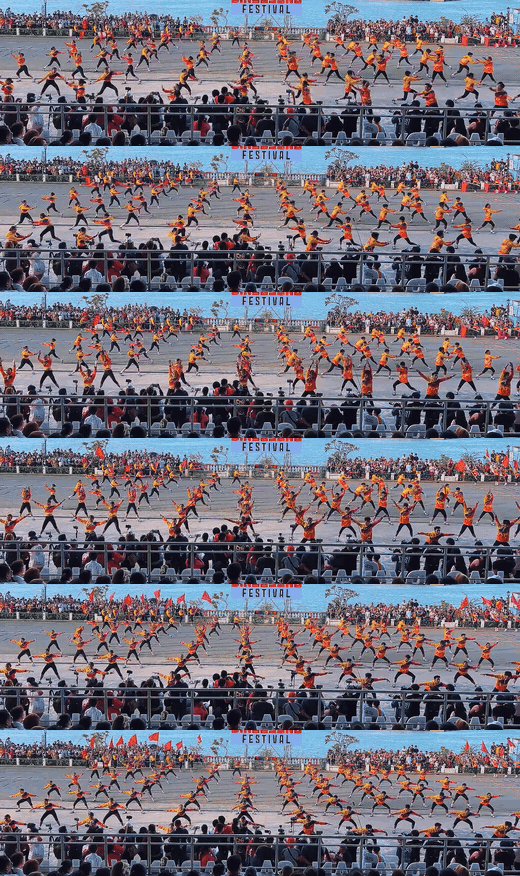
In the climactic battle scene, performers stomp powerfully on the wooden stage floor to launch themselves into dramatic jumps. What they feel is Newton's Third Law: for every action force there is an equal and opposite reaction force — forces always come in pairs. The performer pushes down on the floor (action); the floor pushes up on the performer with equal force (reaction), and it is this upward reaction that propels them into the air. The same pairing lets a performer charge forward: they push a foot backward against the stage, and the stage pushes them forward with an equal force. You never move by pushing yourself — you move by pushing against something that pushes back. The everyday intuition: to go up, push down; to go forward, push back — the surface always returns the favor with an equal, opposite shove.
Third Law During Rehearsal: Push-ups and Planks
Newton's Third Law is not limited to dramatic jumps — it operates throughout every rehearsal exercise. During planking, a performer's hands press downward into the floor while the floor simultaneously pushes upward with equal force, keeping the body suspended against gravity. Even though there is no movement, the action-reaction pair is fully active and essential. Similarly, during push-ups, the downward press of the arms produces an equal upward reaction from the floor that raises the body. These preparatory exercises train the very muscular forces that later power the war scene's leaps and kicks.