Timed Entrances: Speed and Direction in the War Scene
What you’ll learn
By the end of this lesson, you will be able to:
- 1Use + and − signs to show the direction of a performer's movement.
- 2Differentiate speed from velocity.
The player pauses at checkpoints to test your understanding. Too fast? Tap the speed button to slow the narration, use 10s to hear a part again, and keep subtitles on to read along.
Subtitles appear here while the video plays.
Read the full transcript
So, if the change in position -- known as displacement -- is positive, you’ll know
you’ve moved in one of those directions. If it’s negative, you’re traveling the other way.
But which direction is positive, and which is negative? That’s totally arbitrary.
You could decide that east should be positive and west negative, or the other way around
-- but the answers you get will mean the same thing.
You just have to make sure to keep track of which direction is positive, and keep that
in mind when you’re talking about velocity and acceleration, too.
Velocity is the way your position changes over time, and it’s also a pretty big deal.
It’s kind of like speed, but just like with displacement, it also tells you which direction
you’re moving in, based on whether it’s positive or negative.
Now, what about when your velocity changes?
That’s the fourth quality of movement you’ll want to pay attention to: acceleration.
If you’ve ever been in a car when someone slammed on the gas, that feeling of being
pressed back against your seat is acceleration -- your velocity’s changing.
So, how do we plot out all of these different conditions that describe the movement of you
Quiz Checkpoints
Like the video's east-and-west example, the director says stage-right is the positive (+) direction. A performer moves 5 m toward stage-left. How should this displacement be written?
The video says velocity is like speed, but it also tells the direction. Two performers enter the stage at the same speed but from opposite sides. Do they have the same velocity?
The video says a changing velocity is called *acceleration*. A performer jogs onto the stage at 2 m/s, then breaks into a 6 m/s sprint in the same direction. What is happening?
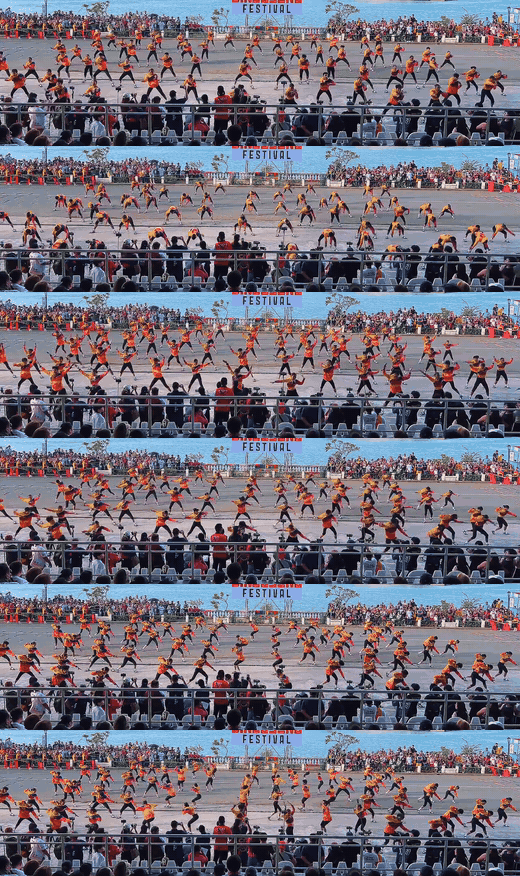
See It in the Festival
The same physics, in the Cry of Jelicuon.