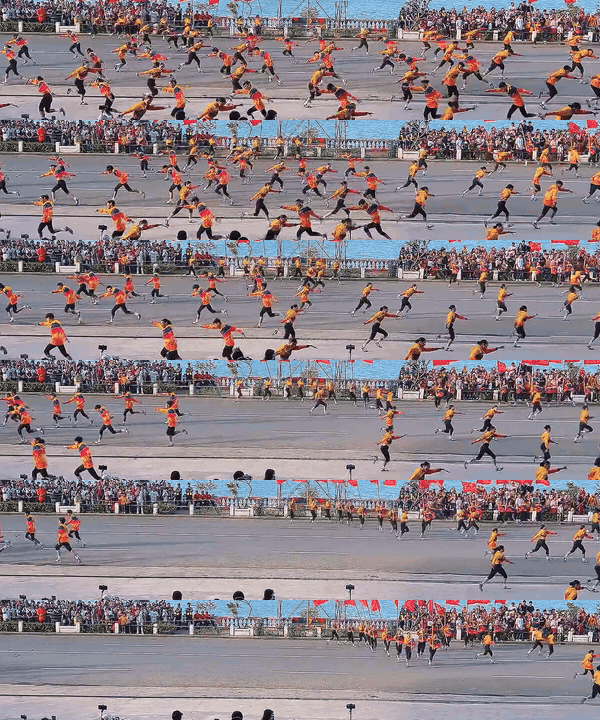
Beat Counts and Direction Changes: Impulse in Action
What you’ll learn
By the end of this lesson, you will be able to:
- 1Relate impulse to the change in a performer's momentum.
- 2Explain why a shorter stopping time needs a bigger force.
The player pauses at checkpoints to test your understanding. Too fast? Tap the speed button to slow the narration, use 10s to hear a part again, and keep subtitles on to read along.
Subtitles appear here while the video plays.
Read the full transcript
Instead, impulse -- usually represented by a J -- is the integral of the net force on
an object over time -- in other words, its change in momentum.
Impulse turns out to be a particularly useful way to describe a crash --
because generally, in collisions, forces change very quickly.
So, if a ball smacks into a wall, and over the course of half a second, its force on
the wall in Newtons is equal to the time, multiplied by 25, we’d say that its impulse was 3.1 Newton-seconds.
Now, let’s consider the different kinds of collisions that we can study.
And we’ll be able to use math to figure out where it went.
And we can use what we know about impulse -- and Newton’s third law -- to prove it.
The third law, of course, is the one that says that every action has an equal and opposite reaction.
And that applies to collisions in the sense that, if a ball hits a wall, it’ll exert a force
on the wall, and the wall will exert an equally strong force on the ball.
We can describe each of these forces as impulses, since we know that an impulse is just
a change in an object’s momentum.
So, the ball’s momentum will be decreasing when it hits the wall. But because of Newton’s
third law, we know that the wall’s momentum is going to increase by an equal amount.
The change in the wall’s momentum might be impossible for us to see, because the wall
is connected to the ground, and Earth has lots of mass. But it’s there.
And that fact -- that momentum is always conserved -- turns out to be super helpful for describing collisions using math.
Quiz Checkpoints
The video says impulse equals the change in momentum. A 50 kg performer running at 4 m/s comes to a complete stop at the end of a charge. How big is the change in momentum?
The video shows impulse as a force acting over a time. A choreographer shortens a direction change from 4 beats to 2 beats, but the change in momentum stays the same. What happens to the force the performer needs?
Like the wall in the video, the stage gets an equal and opposite impulse when a performer stamps on it. Why doesn't the stage visibly move?
See It in the Festival
The same physics, in the Cry of Jelicuon.