


_Municipal_Seal.png&w=64&q=75 "Municipality of New Lucena, Iloilo")
Two Faces of Mechanical Energy in the Festival

In the Cry of Jelicuon, some of the most dramatic moments involve performers perched high on bamboo risers before executing a jump. At that frozen instant — standing motionless at height — they are a perfect example of gravitational potential energy. The moment they leap, that energy begins its transformation.
Gravitational Potential Energy (PE) is stored energy due to an object's position above a reference point: PE = mgh, where m is mass, g is 9.8 m/s², and h is height. The higher an object sits, the more energy it stores — energy that is ready to be released the moment the object moves.
A 55 kg performer stands motionless at the top of a 1.5 m bamboo riser, waiting for the cue to leap. How much gravitational potential energy is stored in their raised body? (use g = 9.8 m/s²)
PE = m × g × hPE = 55 × 9.8 × 1.5PE = 808.5 JAll 808.5 J of this stored energy converts into kinetic energy as the performer falls and lands.

PE = mgh; the higher they lift, the more PE is banked, ready to pour back out as motion (KE) when the props sweep down.Kinetic Energy (KE) is the energy of motion: KE = ½mv². The moment the performer lands, they have converted all their PE into KE (ignoring air resistance). The heavier the performer and the taller the riser, the greater the kinetic energy at landing — and the louder the impact the audience hears.
From Sprint to Roll: Recycling Kinetic Energy
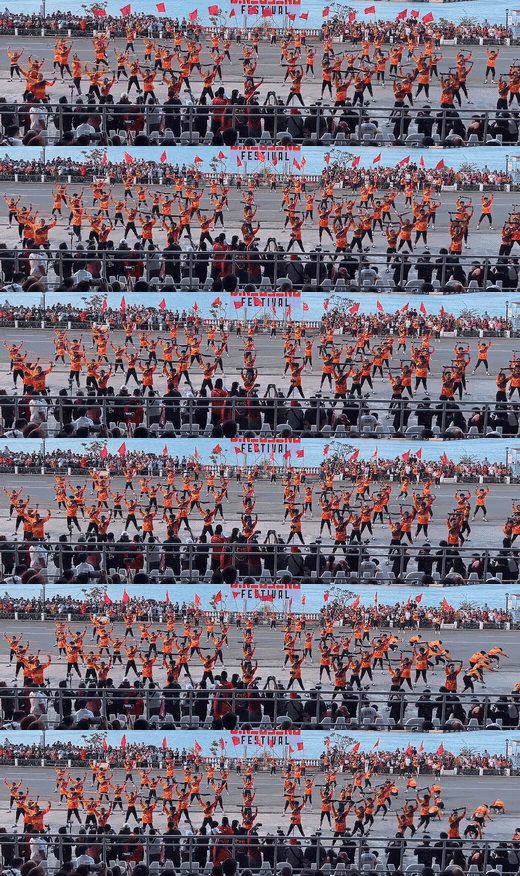
Male performers in the war scene do not simply stop after a run — they transition fluidly into rolls across the stage floor. This is kinetic energy recycling in action: the kinetic energy built up during the sprint is carried into the roll, allowing the performer to dissipate the force of impact gradually while keeping the visual motion smooth. Rather than applying a large stopping force that abruptly cancels all KE, the rolling motion spreads the deceleration over a longer time and distance, protecting the body while sustaining the dramatic visual effect. The choreographer designs these transitions precisely because they are physically safer and visually more powerful than abrupt stops.
The same 55 kg performer leaps from the 1.5 m riser. Falling freely, they reach a landing speed of about 5.4 m/s. How much kinetic energy do they carry at the instant they land?
KE = ½ × m × v²KE = 0.5 × 55 × (5.4)² = 0.5 × 55 × 29.16KE ≈ 801 JLanding speed from a 1.5 m drop is v = √(2gh) ≈ 5.4 m/s. The resulting KE (≈801 J) closely matches the initial PE (808.5 J) — the small difference is due to rounding.